
Free UK shipping on orders over £150
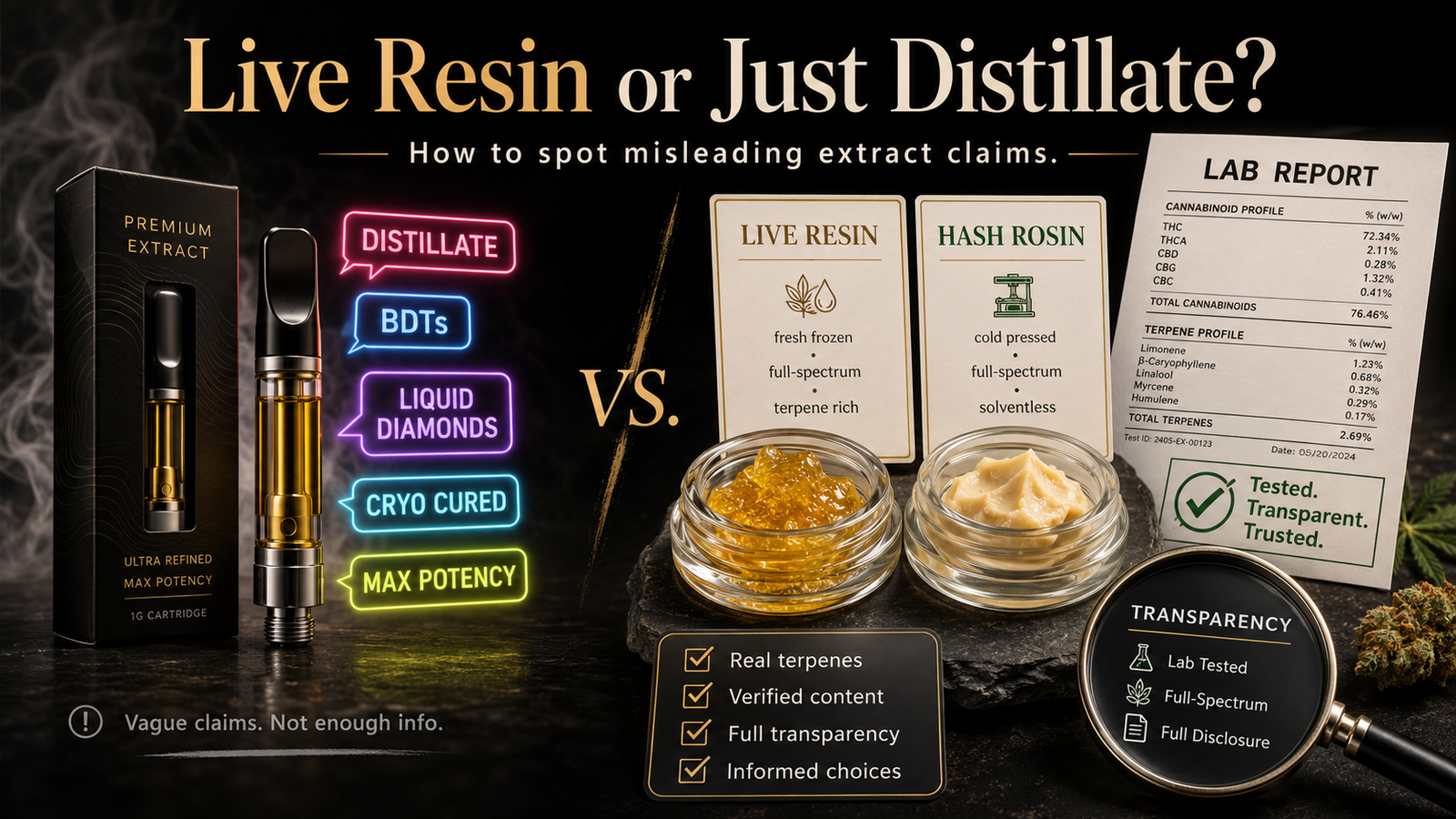
Live resin vs distillate has become one of the biggest conversations in the cannabis extract market.
Consumers are now faced with products labelled live resin, liquid diamonds, live diamonds, cryo-cured diamonds, terp sauce, distillate and hash rosin, often with very little explanation about what those terms actually mean.
And that creates a problem.
A premium-looking vape labelled with words such as “diamonds”, “live” or “cryo cured” does not automatically mean the formulation inside is genuine live resin or hash rosin.
Some products may primarily contain highly refined THC distillate, with flavour created afterwards using cannabis-derived or botanical-derived terpenes (BDTs).
Others may contain cannabinoids produced through chemical conversion from CBD or another cannabinoid.
None of those ingredients should automatically be treated as inherently bad simply because they exist.
The real issue is transparency.
If consumers are paying a premium for a live resin vape or hash rosin vape, they deserve to know what is actually inside it.
Cannabis distillate is a highly refined cannabinoid extract, commonly produced to achieve very high concentrations of THC or another target cannabinoid.
During extensive refinement, much of the original plant’s:
can be removed.
This leaves a relatively neutral cannabinoid-rich oil.
That neutrality is one reason distillate vapes can easily be formulated into flavours such as strawberry, mango, sweets, desserts or gas-style profiles.
Terpenes and flavour compounds can simply be added afterwards.
It can, but those terpenes are usually added back after refinement rather than being preserved naturally throughout extraction.
They may be:
Cannabis-derived terpenes (CDTs)
or
Botanical-derived terpenes (BDTs).
This difference is worth understanding.
BDT stands for botanical-derived terpenes.
Terpenes occur throughout nature, not only in cannabis.
For example, limonene can occur in citrus fruit, while pinene is found in many plants including pine.
These compounds can be isolated from botanical sources and used to flavour a distillate vape.
That doesn’t make BDTs automatically unsafe or inferior.
The important distinction is that:
Distillate + botanical terpenes does not automatically become live resin.
A product can taste sweet, fruity, creamy or gassy while still being fundamentally a flavoured distillate formulation.
That is why consumers comparing live resin vs distillate should look beyond flavour alone.
Live resin is produced with the goal of preserving considerably more of the plant’s original chemical and aromatic profile.
Rather than allowing harvested cannabis material to undergo a conventional drying and curing process before extraction, material intended for live resin is typically preserved rapidly after harvest.
That helps retain volatile compounds that can otherwise be lost.
A genuine live resin extract therefore tends to preserve considerably more of the cultivar’s original:
than highly refined distillate.
That’s one of the biggest differences when comparing live resin vs distillate vapes.
A distillate vape and a genuine live resin vape can both contain substantial concentrations of THC.
But they are fundamentally different types of extract.
| Characteristic | Distillate Vape | Live Resin Vape |
|---|---|---|
| THC concentration | Often extremely high | Usually high |
| Original terpene profile | Mostly removed | Better preserved |
| Added terpenes | Common | May be unnecessary or limited |
| Cultivar expression | Relatively low | Generally much stronger |
| Flavour | Often formulated afterwards | More connected to starting material |
| Processing | Highly refined | Designed to preserve more compounds |
This doesn’t necessarily mean one product will make every person “more high” than another.
Dose matters enormously.
A large inhalation of very potent distillate can obviously produce stronger intoxication than a tiny inhalation of live resin.
The difference consumers often describe is more about the character of the experience.
Many consumers describe distillate as producing a particularly:
direct
THC-forward
strong
fast
and sometimes one-dimensional
experience.
Some experienced consumers describe it as simply feeling “high” without much distinction between strains.
There is a logical reason this might happen.
If the formulation is dominated by highly refined THC with a relatively limited original chemical profile, much of the cultivar-specific chemistry has already been removed.
However, this shouldn’t be turned into an absolute scientific rule.
Individual cannabis effects can vary enormously depending on:
People comparing live resin vs distillate commonly describe live resin as feeling more:
rounded
complex
cultivar-specific
layered
balanced
than distillate.
One live resin cultivar may feel noticeably different from another even when their THC percentages are relatively similar.
That difference may relate partly to the broader chemical profile retained in the extract.
Cannabis contains far more than THC alone.
There are numerous:
minor cannabinoids
terpenes
aromatic compounds
that can potentially influence the overall experience.
However, consumers should be wary of companies claiming that an “entourage effect” guarantees a specific medical or psychoactive result.
Research into cannabinoid and terpene interactions is developing, but the effects are much more complicated than many marketing claims suggest.
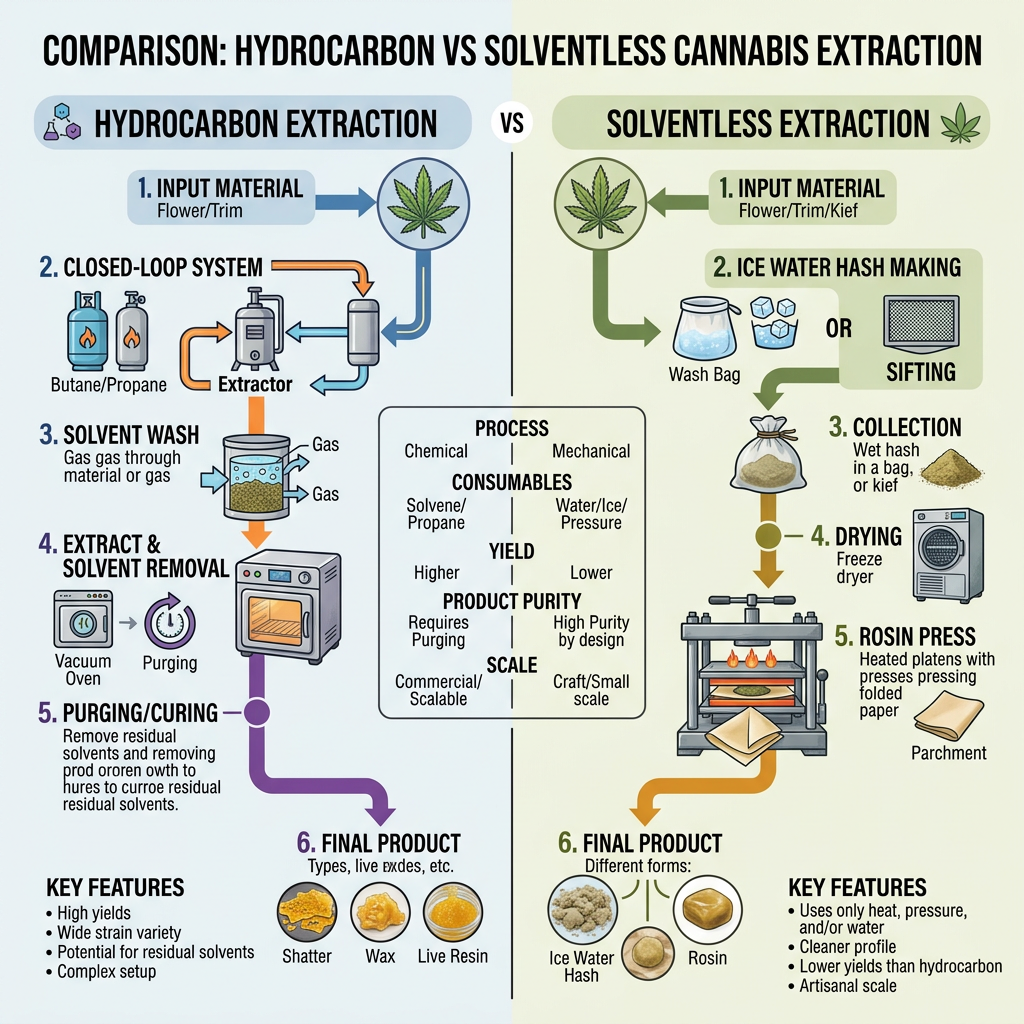
Hash rosin is another premium cannabis concentrate, but it is produced very differently from live resin.
Live resin typically uses a solvent-based extraction process followed by careful removal of those solvents.
Hash rosin is solventless.
High-quality hash is mechanically separated from plant material and then pressed using controlled heat and pressure.
This creates a concentrate valued for preserving:
without requiring hydrocarbon extraction.
When comparing live resin vs hash rosin, neither automatically means “better”.
They represent different extraction philosophies.
Usually:
Usually:
Many connoisseurs describe hash rosin as producing an especially full and complex experience.
But again:
Solventless does not mean risk-free, and rosin does not automatically guarantee a better high.
Starting material, contaminants, cannabinoid concentration, hardware and consumption patterns all matter.
A useful general comparison looks like this:
| Extract | Commonly reported experience | Plant profile |
|---|---|---|
| Distillate | Strong, direct, THC-focused | Limited |
| Live Resin | Layered, aromatic, cultivar-specific | High |
| Hash Rosin | Rich, complex, full-bodied | High |
These are general consumer descriptions, not guarantees.
THC remains intoxicating regardless of whether it comes from distillate, live resin or hash rosin.
High-potency extracts can also increase the likelihood of unwanted effects such as:
particularly when consumed heavily.
Liquid diamonds generally refers to formulations created using highly concentrated cannabinoid material originally formed as cannabinoid crystals or “diamonds”.
But the words liquid diamonds alone don’t tell you what the complete vape formulation contains.
Consumers should ask:
What cannabinoid are the diamonds made from?
What are they mixed with?
Is there genuine cannabis-derived sauce?
Is there live resin?
Are the terpenes cannabis-derived?
Is distillate included?
Have any cannabinoids been chemically converted?
These questions become especially important with products marketed as:
Live Diamonds
Cryo-Cured Diamonds
Diamond Sauce
Liquid Diamonds
because those names can sound extremely premium without clearly describing the formulation.
Not necessarily.
Cryo-cured diamonds is not by itself enough information to determine what is inside a vape.
Freezing, crystallisation or low-temperature processing may genuinely be involved in producing certain extracts.
But consumers should still ask what makes up the final formulation.
A cannabinoid crystal combined with distillate and botanical terpenes is chemically different from a formulation based predominantly on genuine live resin or cannabis-derived terpene sauce.
Premium terminology shouldn’t replace ingredient transparency.
Another growing issue in the extract market is converted cannabinoids, sometimes referred to as semi-synthetic cannabinoids.
These are cannabinoids produced by chemically transforming another cannabinoid.
CBD is frequently used as the starting material.
Examples that have appeared in international markets include:
Delta-8 THC
HHC
HHC-P
and numerous newer cannabinoid derivatives.
It is important not to confuse these automatically with fully synthetic cannabinoids such as those historically associated with “Spice”.
They’re different categories.
However, converted cannabinoids introduce their own questions.
There isn’t enough long-term human research to confidently establish the safety profile of many newer converted cannabinoids.
That’s the central issue.
Conversion chemistry can involve:
When performed improperly or without sufficient purification, unwanted reaction products can remain.
Possible concerns include:
residual solvents
reaction by-products
unexpected cannabinoid isomers
heavy metals
incorrect potency
undeclared compounds
The uncertainty becomes particularly concerning when a consumer has no idea that the cannabinoid was chemically converted in the first place.
For many newer semi-synthetic cannabinoids, we genuinely don’t know yet.
There simply isn’t enough high-quality long-term human research.
That means consumers should be sceptical of both extremes.
It isn’t scientifically responsible to claim that every converted cannabinoid definitely causes serious long-term harm.
But it is equally irresponsible to claim that they are proven safe.
Lack of evidence of harm is not the same as evidence of safety.
That is why transparency and comprehensive testing matter.
Cannabis vape safety isn’t only about THC percentage.
A meaningful vape testing programme should consider:
And where converted cannabinoids are present, laboratories may also need to investigate:
unexpected isomers
reaction by-products
conversion residues
A simple potency test showing “90% cannabinoids” does not necessarily tell the whole story.
Another issue consumers often overlook is what happens when an extract is heated.
Cannabinoids, terpenes and other components can undergo thermal degradation.
The compounds produced can depend on:
This is why good hardware matters alongside good extract.
A premium concentrate placed inside poorly designed hardware can still produce a poor vaping experience.
Cannabinoids have legitimate therapeutic uses in particular clinical circumstances.
Research has investigated cannabinoids for areas including:
But consumers should be very careful with marketing claims.
Science has not established that live resin is automatically more medicinal than distillate, or that hash rosin is automatically the most therapeutic cannabis extract.
The effect depends far more on:
which cannabinoids are present
the dose
CBD:THC ratios
minor cannabinoids
route of administration
the individual
the condition being treated
Anyone using cannabinoids medicinally should seek appropriate medical advice rather than relying on product marketing.
Even though medical superiority hasn’t been proven, many consumers prefer extracts that retain more of the original plant profile.
That is one reason interest in:
live resin vapes
hash rosin vapes
full-spectrum extracts
has grown substantially.
Consumers increasingly want to know:
What cultivar did this come from?
What terpenes naturally occurred in it?
Was the extract heavily refined?
Were flavours added afterwards?
Was the cannabinoid chemically converted?
That’s a positive development.
An educated market rewards transparency.
We think this distinction is important.
Distillate isn’t automatically bad.
BDTs aren’t automatically bad.
A well-produced distillate vape using botanical flavouring can be exactly what some consumers want.
The problem is calling that formulation something it isn’t.
If you’re buying distillate, it should be sold as distillate.
If botanical terpenes are responsible for the flavour, brands should be comfortable saying so.
And if cannabinoids were produced through chemical conversion, consumers deserve to know.
At DOOB-E, our approach is straightforward:
If we call something live resin, we want it to genuinely represent live resin.
If we’re offering hash rosin, consumers should know they’re receiving a genuine rosin-based extract.
We’re interested in:
starting material
cultivar expression
natural terpene profiles
aroma
extract quality
transparency
rather than simply creating a flavour that resembles cannabis and placing a premium extract name on the packaging.
Premium extracts cost more to produce.
They require better starting material, more careful processing and greater attention to the finished formulation.
But premium shouldn’t only describe the branding.
Consumers comparing live resin vs distillate should look beyond packaging.
Ask:
Is the base actually live resin?
Does the brand disclose ingredients?
Are terpenes cannabis-derived or botanical-derived?
Does the company publish laboratory testing?
Are pesticides tested?
Are heavy metals tested?
Are residual solvents tested?
Have any cannabinoids been chemically converted?
Does the cannabinoid and terpene profile make sense for the product being advertised?
The more transparent the brand is willing to be, the easier those questions become.
Not necessarily.
Distillate frequently has a higher THC percentage, while live resin generally retains a broader aromatic and cannabinoid profile.
Actual intoxication depends primarily on dose, potency, tolerance and individual response.
It depends on what you’re looking for.
Consumers wanting maximum THC concentration may prefer distillate.
Consumers seeking greater cultivar expression, natural flavour and terpene complexity may prefer live resin.
Neither is automatically superior.
Hash rosin is solventless, while live resin typically uses solvent-based extraction. Both can produce exceptionally high-quality concentrates.
Botanical terpenes aren’t automatically unsafe simply because they come from non-cannabis plants.
However, terpene concentration, formulation quality and heating conditions matter.
Converted cannabinoids are cannabinoids produced by chemically transforming another cannabinoid, often CBD.
Some newer semi-synthetic cannabinoids have limited long-term safety data.
Not always.
A genuine diamond-based formulation can exist, but the term alone doesn’t tell consumers what else is included.
Always check the full formulation and laboratory testing.
Live resin generally involves solvent-based extraction of preserved plant material.
Live rosin is produced mechanically without hydrocarbon extraction solvents, typically from fresh-frozen material processed into hash before pressing.
Consumers are becoming more knowledgeable every year.
People understand more about:
live resin
distillate
hash rosin
liquid diamonds
terpenes
converted cannabinoids
vape hardware
laboratory testing
than ever before.
That means premium terminology and colourful packaging can only go so far.
The brands that earn long-term trust will be the brands willing to tell consumers exactly what they’re buying.
Distillate should be called distillate.
Botanical-derived terpenes should be disclosed as botanical-derived terpenes.
Converted cannabinoids should be disclosed as converted cannabinoids.
Live resin should actually be live resin.
Hash rosin should actually be hash rosin.
That shouldn’t be controversial.

Cannabis has never just been about what
Live resin vs distillate has become one
What Is Live Resin? Live resin is

Unlocking the DOOB-E Experience DOOB-E gives customers